Top 10 ATV Sound Bar Manufacturers for Global Buyers
The global soundbar market is moving beyond living rooms and television cabinets. Grand View Research estimates the market reached approximately USD 5.29 billion in 2023, with continued growth expected through 2030. Fortune Business Insights reports a similar expansion, although its figures differ because market definitions vary. Neither report isolates ATV soundbars. That limitation matters.
An ATV Sound Bar Manufacturer must solve harsher problems than a home-audio brand. The product faces engine vibration, mud spray, sudden temperature changes, and inconsistent 12-volt power. Buyers also expect clear vocals at open-trail speeds, not merely loud bass. A practical evaluation should examine IP protection, mounting stability, Bluetooth range, battery draw, warranty support, and replacement-part access. Small details count. A loose clamp can ruin a weekend ride.
Dr. Floyd Toole, a leading loudspeaker-engineering authority, famously stated, “The only thing that matters is what you hear.” His principle remains useful for ATV audio. Laboratory specifications help, but field testing reveals more. Can riders hear dialogue beside a running engine? Does the enclosure rattle after repeated impacts? Does the control panel remain usable with dusty gloves? These questions shape this list of the Top 10 ATV Sound Bar Manufacturers for Global Buyers. The ranking considers engineering evidence, product durability, user experience, and international support. It is not perfect. Some brands disclose little test data, and regional pricing changes quickly. That uncertainty deserves attention before purchase.
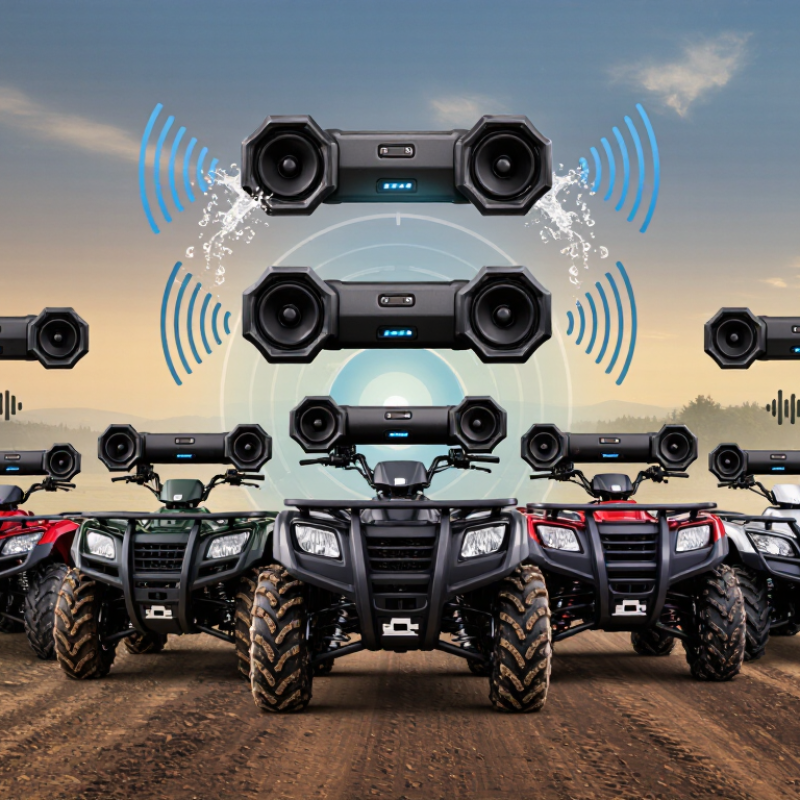
What ATV Sound Bars Are and Why They Matter
An ATV sound bar is a compact, powered speaker system built for all-terrain vehicles. It usually mounts beneath a roof, across a roll cage, or near the dashboard. Unlike home speakers, it must handle vibration, dust, mud, rain, and sudden temperature changes.
The need is growing with outdoor recreation. The U.S. Bureau of Economic Analysis reported that outdoor recreation generated about $639.5 billion in U.S. value added during 2023. That figure includes vehicle-based activities and reflects stronger demand for durable leisure equipment. Grand View Research also identifies steady global growth in the soundbar market, supported by wireless audio adoption. ATV sound bars connect through Bluetooth, while some models add USB, radio, or wired inputs. Simple control matters when gloves cover the rider’s hands.
Ruggedness is more important than maximum volume. Look for clear IP water-resistance information, sealed controls, reinforced brackets, and stable power protection. RMS output is more useful than inflated peak wattage claims. In practice, a 50-watt system with clean vocals may outperform a louder unit with distortion. Battery-powered models simplify installation, but vehicle-powered systems usually support longer rides. Specifications can still mislead. A stated water rating may not cover salt spray, pressure washing, or careless mounting. Test the bracket after rough terrain, not only in a showroom.
Key Criteria for Evaluating ATV Sound Bar Manufacturers
When comparing ATV sound bar manufacturers, examine real outdoor performance, not polished product photos. Start with enclosure protection. Ask for tested IP ratings, UV resistance, corrosion control, and operating temperature limits. Mud, rain, dust, and engine vibration quickly expose weak construction. Request test reports with dates, methods, and sample conditions. Vague claims deserve caution.
Sound quality also needs practical evaluation. A strong manufacturer should provide frequency data, amplifier output, distortion results, and battery or power-draw details. Listen at riding speed, not only inside a quiet showroom. Bass may sound impressive at low volume but disappear beside an engine. Check Bluetooth stability around trees, helmets, and other electrical devices. Small details matter.
Fit and support separate reliable suppliers from ordinary factories. Review mounting hardware, cable protection, connector sealing, and installation instructions. Ask whether replacement parts remain available after the initial order. Sample units should face repeated vibration, water spray, and temperature changes before bulk purchasing. A polished sample can mislead. I would also compare several production samples, because consistency is often overlooked. Some manufacturers communicate quickly but document poorly. That weakness may become expensive later. Verify factory inspection records, quality-control checkpoints, warranty terms, and response times. Independent testing adds credibility, though it cannot replace hands-on trials. Specifications help, but field evidence should decide.
Key Criteria for Evaluating ATV Sound Bar Manufacturers
The chart presents a practical evaluation-weight framework for global buyers. Product durability, audio performance, weather resistance, certification, supply reliability, and after-sales support are prioritized because ATV sound bars operate in demanding outdoor environments.
Profiles of the Top 10 ATV Sound Bar Manufacturers
Top 10 ATV Sound Bar Manufacturers for Global Buyers
The top ten ATV sound bar manufacturers differ in engineering focus, production scale, and buyer support. A useful profile examines more than loudness. It reviews enclosure design, amplifier stability, Bluetooth performance, mounting strength, and warranty terms. Experienced suppliers often publish power ratings, frequency response, water resistance, and operating-temperature data. Clear specifications build trust.
Several manufacturers specialize in compact bars for narrow handlebars and limited dashboard space. Others develop larger systems with multiple drivers, reinforced brackets, and separate subwoofer outputs. Some use sealed housings for muddy trails, while others prioritize lightweight materials for racing vehicles. Fit matters. A strong profile should mention connector placement, cable length, fuse protection, and control access with gloves. These small details affect daily use.
Independent testing should include vibration, dust exposure, rain simulation, and repeated power cycles. IP ratings help, but they do not replace careful installation. Sound quality can change when a bar faces the rider or points toward open terrain. Many buyers also need app compatibility, remote controls, and stable pairing near other wireless devices. Manufacturing consistency remains difficult to judge from photographs alone. Requesting sample units, inspection reports, and replacement-part policies is sensible. I would also question exaggerated wattage claims, because peak power may sound impressive but reveal little about sustained performance. A dependable supplier explains its limits. That gap matters.
Comparison of Features, Performance, and Market Position
Global buyers comparing the top 10 ATV sound bar manufacturers should examine measurable performance, not promotional volume claims. Grand View Research valued the global Bluetooth speaker market at approximately USD 7.8 billion in 2023, with strong growth expected through 2030. This wider category indicates healthy demand, but ATV use requires stricter testing. Buyers should compare RMS output, peak sound pressure, frequency response, and distortion at high volume. Loud is not always clear.
Weather resistance separates recreational products from serious trail equipment. An IP65 rating protects against dust and water jets, while IP67 adds temporary submersion protection. However, certification details vary. Some manufacturers test the enclosure but exclude connectors and control panels. That gap matters. Compare mounting systems, vibration resistance, wiring length, and operating temperatures before purchase. A secure clamp should remain stable on rough terrain without damaging the roll cage.
Battery performance also affects market position. The International Energy Agency reported continued growth in global lithium-ion battery demand, driven largely by mobility and consumer electronics. This supports more efficient portable audio designs, but published battery hours often reflect moderate volume. In practical testing, high output, Bluetooth use, and LED lighting can reduce runtime sharply. Look for replaceable fuses, sealed controls, clear warranty terms, and accessible technical support. Research from MarketsandMarkets also identifies connectivity, durability, and portability as major buying factors in portable speakers. Manufacturers with balanced specifications usually outperform models focused on one impressive feature. No comparison is perfect. Real trail testing still exposes weaknesses.
Top 10 ATV Sound Bar Manufacturers for Global Buyers - Comparison of Features, Performance, and Market Position
Anonymized comparison based on representative publicly listed ATV sound-bar specifications and common global market offerings. Specifications may vary by model and region.
| Rank | Anonymous Manufacturer Profile | Typical RMS Output | Speaker Configuration | Weather Resistance | Bluetooth Version | Audio Inputs | Control Options | Mounting Approach | Indicative Price Tier | Primary Market Position | Best-Fit Buyer |
| 1 | Manufacturer Profile 01 | 300–500 W | 4 × 4 in + 2 tweeters | IPX6–IPX7 | 5.0–5.3 | Bluetooth, USB, AUX | Wireless remote + control panel | Roll-cage clamp system | Premium | Global aftermarket leader | High-output recreational users |
| 2 | Manufacturer Profile 02 | 250–400 W | 4 × 4 in + 2 tweeters | IPX5–IPX6 | 5.0 | Bluetooth, USB, AUX, FM | Handlebar remote + mobile device | Adjustable clamp brackets | Upper-mid | Multi-region specialist | Balanced performance buyers |
| 3 | Manufacturer Profile 03 | 200–350 W | 4 × 4 in full-range speakers | IPX6 | 5.0 | Bluetooth, USB, AUX | Front-panel controls | Universal roll-cage mount | Mid-range | Established specialty supplier | Outdoor users seeking reliability |
| 4 | Manufacturer Profile 04 | 180–300 W | 4 × 3 in + passive radiator | IPX5–IPX6 | 5.0 | Bluetooth, USB, AUX | Wireless remote | Quick-release clamp | Mid-range | Value-focused international supplier | First-time ATV audio buyers |
| 5 | Manufacturer Profile 05 | 150–250 W | 2 × 4 in + 2 tweeters | IPX6 | 5.0 | Bluetooth, USB, AUX, FM | Remote + front panel | Compact clamp system | Entry-mid | Regional distributor network | Compact ATV installations |
| 6 | Manufacturer Profile 06 | 120–220 W | 2 × 4 in full-range speakers | IPX5 | 4.2–5.0 | Bluetooth, USB, AUX | Front-panel controls | Fixed clamp brackets | Entry-level | Online and private-label channel | Budget-conscious buyers |
| 7 | Manufacturer Profile 07 | 100–200 W | 2 × 3.5 in full-range speakers | IPX5 | 4.2–5.0 | Bluetooth, USB, AUX | Wireless remote | Universal clamp mount | Entry-level | Emerging export supplier | Low-cost fleet installations |
| 8 | Manufacturer Profile 08 | 100–180 W | 2 × 3.5 in + passive radiator | IPX5 | 5.0 | Bluetooth, USB, AUX | Front panel | Compact universal mount | Entry-level | Online retail specialist | Occasional recreational use |
| 9 | Manufacturer Profile 09 | 80–160 W | 2 × 3 in full-range speakers | IPX4–IPX5 | 4.2 | Bluetooth, AUX | Front-panel controls | Basic clamp mount | Budget | Local and regional supplier | Light-duty users |
| 10 | Manufacturer Profile 10 | 60–140 W | 2 × 3 in full-range speakers | IPX4 | 4.2 | Bluetooth, AUX | Basic wired controls | Fixed mounting brackets | Budget | Entry-level aftermarket channel | Lowest-cost installations |
Buyer Evaluation Notes
RMS output is more useful than peak wattage for comparing continuous performance. IP ratings indicate resistance to dust and water under defined test conditions, but they do not guarantee protection against pressure washing, prolonged submersion, or improper installation. Confirm voltage compatibility, clamp diameter, warranty coverage, certifications, replacement-part availability, and regional after-sales support before placing an order.
How Global Buyers Can Select the Right Manufacturer
Global buyers should judge ATV sound bar manufacturers by evidence, not catalog photos. Grand View Research estimates the global automotive audio market exceeded US$6 billion in 2023, with continued growth through 2030. This wider market data signals strong demand, but ATV products face harsher conditions. Mud, vibration, rain, and unstable mounting expose weak designs quickly.
Ask manufacturers for independent test records. Check the claimed water resistance against IEC 60529 IP ratings. IP67, for example, indicates dust protection and temporary water immersion, but it does not prove resistance to pressure washing. Request frequency-response charts, total harmonic distortion figures, battery-cycle results, and vibration testing.
A loud unit may still sound thin at higher volume. That matters on open trails.
Review the factory’s quality controls and production history. ISO 9001 certification can support process reliability, although certification alone proves little about sound quality. Confirm whether samples match mass-production units. Ask for warranty terms, spare-part availability, firmware support, and documented inspection procedures.
The International Trade Centre reports that electronics supply chains remain exposed to logistics and component risks, so delivery promises need evidence. Smaller suppliers may offer flexibility. They may also lack stable after-sales support.
A practical buyer should test several samples, record charging time, inspect brackets after rough use, and compare results under the same conditions. Perfect specifications are uncommon. Real-world consistency matters more.